
How to handle routine changes for children with autism without increasing anxiety
Do changes in routine cause anxiety for your child with autism? Learn practical strategies to prepare for transitions, reduce stress, and help them adapt more calmly.
7/6/20263 min read

A change of plans that might seem minor to many people—such as leaving the house later than usual or taking a different route to school—can be very stressful for some children with autism.
This does not mean the child is being "difficult" or uncooperative. In many cases, routines provide a sense of security and help the child anticipate what will happen next.
When that predictability is unexpectedly lost, anxiety can rise, leading to behaviors such as crying, irritability, or a refusal to participate in an activity.
The good news is that there are strategies to make transitions easier and help the child adapt gradually.
Why are routines important for many children with autism?
Routines make the day more predictable.
Knowing what comes next can reduce uncertainty and make it easier to participate in daily activities.
When a change occurs without preparation, the brain must quickly reorganize that information—a task that can be particularly challenging for some individuals with autism.
Changes that often trigger anxiety
Common examples include:
* The start or end of the school year.
* Holidays or vacations.
* Trips.
* Family visits.
* Moving house.
* Changing teachers.
* Changing therapists.
* Medical appointments.
* Cancellation of an anticipated activity.
Each child will react differently depending on their age, past experiences, and individual needs.
1. Prepare them for the change whenever possible
If you know a change is coming, try to communicate it in advance.
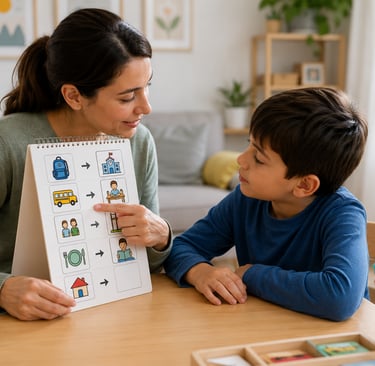
You can do this using simple words, photographs, or a visual schedule.
Advance notice reduces the element of surprise.
2. Explain what will change... and what will stay the same
Instead of simply saying:
"We aren't going to the park today."
You could add:
"Afterward, we’ll come home to play with your blocks."
Knowing what remains constant can provide a sense of security.
3. Use calendars or visual aids
Marking the day of the change on a calendar or showing a visual sequence helps the child better understand what will happen.
This is especially useful for major changes, such as going on vacation or starting school.
4. Keep other routines stable
Even if one part of the day changes, try to maintain other habits.
For example:
* mealtimes;
* bedtime stories;
* bath time;
* relaxing music.
These familiar routines act as points of reference.
5. Validate their emotions
If the child seems worried, avoid phrases like:
"It's nothing to worry about."
Instead, you might say:
"I understand that this change can be difficult. I am here to help you."
Acknowledging their emotions does not mean reinforcing their fear; rather, it offers support.
6. Introduce small changes gradually
Not all changes have to happen all at once.
Whenever possible, make transitions progressive.
For example, visiting the new school before the first day or meeting the new therapist beforehand can make the environment feel more familiar.
7. Have a plan in case the change doesn't go as expected
Sometimes, even with preparation, the child may feel overwhelmed.
In such cases, the following can help:
* finding a quiet place;
* allowing a few minutes of downtime;
* using an object that provides a sense of security;
* resuming the activity once they are calmer, if possible.
Each situation provides information that helps you better handle the next one.
Common mistakes
Avoid:
* changing plans at the last minute when it can be avoided;
* ridiculing the fear of change;
* comparing the child to others;
* introducing several major changes on the same day;
* expecting immediate adaptation.
When should you consult a professional?
If anxiety regarding changes significantly affects daily life or prevents participation in usual activities, it is advisable to discuss this with the team of professionals supporting the child.
They can suggest strategies tailored to the child's needs.
Conclusion : Change is a part of life, and with support, many children with autism can learn to cope with it better.
The key lies not in avoiding change altogether, but in preparing for it whenever possible, providing a sense of security, and respecting each child's pace of adaptation.
Over time, many families find that transitions become more manageable when the child knows what to expect and feels supported by the adults around them.
Frequently Asked Questions (FAQ)
Do all children with autism need very strict routines?
No. The need for structure varies greatly from person to person. Some adapt easily, while others require more advance notice.
What should I do if an unexpected change occurs?
Stay calm, explain the situation using simple language, and provide information about what will happen next.
Can visual aids help during a transition?
Yes. Many families find it helpful to use calendars, photographs, or visual sequences to anticipate changes and make them easier to understand.
Explore
Join us in the adventure of parenting.
Resources
Support
2021 © 2025. All rights reserved.