
How to Help Siblings of Children with Autism: A Real Guide to Strengthening the Family
Learn how to help siblings of children with autism with practical, emotional, and respectful strategies that strengthen family bonds.
6/2/20262 min read
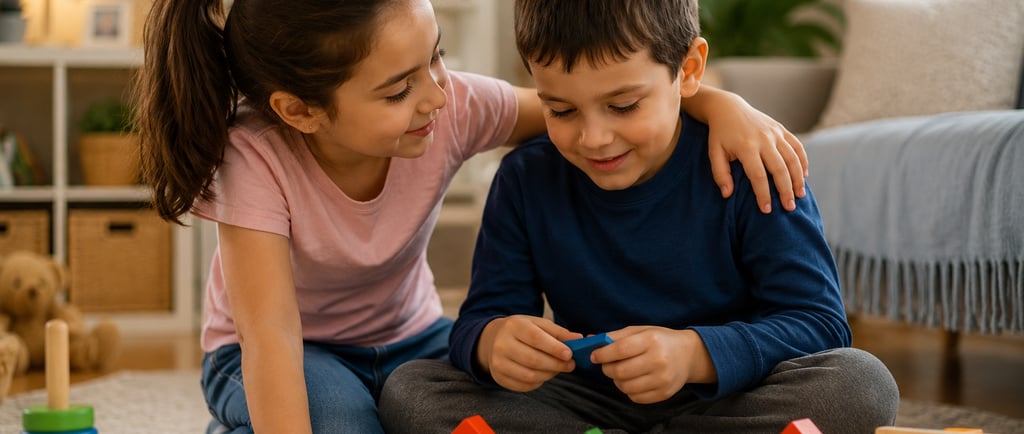
When a child has autism, the whole family experiences changes.
But there's someone who often gets overlooked:
👉 the siblings.
Some feel love and protection.
Others may experience:
confusion
sadness
jealousy
frustration
guilt for feeling this way
And here's something important:
💡 Having mixed emotions is normal.
Helping siblings doesn't mean demanding adult maturity from them…
👉 it means providing them with emotional support as well.
🧠 How can autism affect siblings?
Every family is different.
But some siblings may feel:
😕 Confusion
They don't understand why their sibling acts differently.
They may wonder:
"Why does he yell?"
"Why doesn't he play the same way?"
😔 Feeling displaced
In many families, the child with greater needs receives more attention.
This can lead the sibling to think:
👉 “They don’t pay attention to me anymore.”
Even if no one says it outright.
😟 Shame or Social Anxiety
Some children don't know how to handle comments from others.
Especially at:
school
family gatherings
public places
💙 Excessive Responsibility
Sometimes the older sibling starts to feel like a "mini-adult."
And that can be too much emotional weight.
🗣️ 1. Talk about autism clearly and simply
Many parents avoid the topic thinking that "they'll understand eventually."
But explaining helps a lot.
Simple example:
👉 "Your sibling learns and feels some things differently."
Adapt the explanation according to their age.
The important thing is:
✔ honesty
✔ calmness
✔ no fear
👂 2. Listen to how they feel (without judgment)
Sometimes a sibling might say:
"I'm tired."
"I feel bad."
"I don't like it when they yell."
And that doesn't mean it's a bad thing.
🚫 Avoid responding with:
“Don’t say that.”
✔ Better test:
👉 “I understand that this makes you feel difficult.”
Validating emotions builds trust.
⏰ 3. Dedicate individual time
It doesn't have to be perfect or huge.
But it does have to be important.
Even 20 minutes can make a difference.
Examples:
✔ Walking together
✔ Reading
✔ Cooking
✔ Talking before bed
The message is:
💙 “You are important too.”
🤝 4. Don't give them responsibilities that aren't theirs to bear
Helping is positive.
But they shouldn't feel responsible for their sibling's overall well-being.
Avoid phrases like:
❌ “You have to understand because he has autism.”
Or:
❌ “Always take care of your brother.”
Childhood is theirs too.
🧩 5. Look for activities where you can connect
Not everything should revolve around autism.
Find shared spaces.
Examples:
✔ simple games
✔ music
✔ creative activities
✔ quiet walks
Many sibling relationships strengthen gradually.
🏫 6. Prepare them for questions from others
Teaching simple answers can help.
Example:
👉 “My brother has autism and does some things differently.”
This can reduce social anxiety.
🚨 Signs that a sibling needs more emotional support
Pay attention if you notice:
persistent sadness
frequent anger
isolation
anxiety
significant changes in behavior
Sometimes talking to a professional can be very helpful.
❌ Common mistakes
thinking “they’re fine because they don’t complain”
demanding too much maturity
ignoring difficult emotions
comparing siblings
making one carry too much of the burden
CONCLUSION:
Raising a child with autism can be challenging…
But also taking care of the emotional well-being of their siblings makes a huge difference.
💡 A strong family isn’t one without difficulties.
👉 It’s one that learns to support each other better.
And often, small moments of connection build very beautiful relationships between siblings 💙
Explore
Join us in the adventure of parenting.
Resources
Support
2021 © 2025. All rights reserved.