
My child with autism covers their ears: possible causes and how to help
Does your child with autism cover their ears or avoid certain noises? Discover the possible causes, practical strategies to help them, and when it is advisable to consult a professional.
7/6/20263 min read
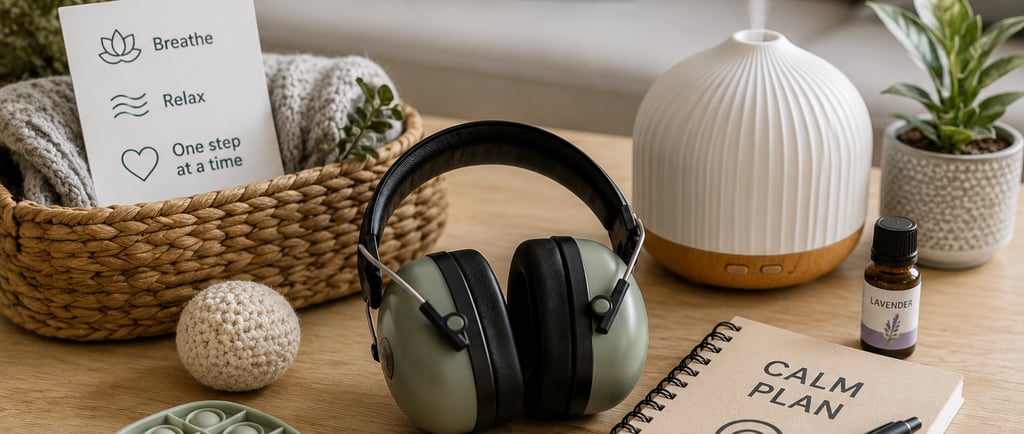
Many parents notice that their child with autism covers their ears when hearing certain sounds.
This can happen in a supermarket, at a party, when turning on the vacuum cleaner, or even at the sound of a hand dryer in a public restroom.
It is natural to wonder:
* Is the noise painful?
* Are they overreacting?
* How can I help?
In many cases, this reaction is related to how some people with autism process sensory stimuli. It does not mean that all children with autism are sensitive to noise, nor that they all react in the same way.
Understanding what might be happening is the first step toward offering support respectfully.
Why do some children with autism cover their ears?
The brain constantly receives information through the senses.
For some people with autism, certain sounds may be perceived with much greater intensity than for others.
This can make an everyday noise feel uncomfortable, annoying, or even overwhelming.
Covering their ears can be a way to protect themselves and reduce that discomfort.
What is auditory sensitivity?
Auditory sensitivity is an intense response to specific sounds.
It does not mean the child "hears better," but rather that they process certain stimuli differently.
The intensity and triggers vary from person to person.
Sounds that can be difficult
Every child is different, but some common examples include:
* Vacuum cleaners.
* Hair dryers.
* Blenders.
* Sirens.
* Fireworks.
* Doorbells.
* School bells.
* Automatic hand dryers.
* Places with many simultaneous conversations.
It is important to remember that what bothers one child might not affect another.
How to identify triggers
Keeping a record can help you spot patterns.
Observe:
* What sound was present?
Where did it happen? Were there a lot of people around?
* Was the child tired or hungry?
* Did the noise start suddenly?
Over time, this information can help you anticipate challenging situations.
Strategies that can help
1. Anticipate sounds
If you know there will be a loud noise, explain it in simple terms before it happens.
Anticipation can reduce the element of surprise.
2. Look for quiet spaces
Whenever possible, provide a place where the child can rest for a few minutes if they feel overwhelmed.
It won't always be possible to avoid the noise, but you can reduce the time spent exposed to it.
3. Consider hearing protection if appropriate
Some families find noise-reducing ear protectors or headphones useful in specific situations, such as at concerts, in airports, or during fireworks displays.
It is advisable to consult the professional working with the child to determine whether this strategy is appropriate for their specific case.
4. Respect their need to step away
If the child tries to move away from a loud sound—and provided it is safe to do so—allowing them to put some distance between themselves and the noise can help them calm down.
5. Introduce new sounds gradually
In some cases, becoming familiar with a sound in a quiet, controlled environment can make it less startling when it occurs in everyday life.
This process should be carried out without forcing the child and while always respecting their boundaries.
What to avoid
Avoid:
* forcing the child to stay near a sound they find very distressing;
* saying they "need to get used to it" without offering support;
* ridiculing their reaction;
* comparing their sensitivity to that of other children;
* assuming that all sounds affect them in the same way.
Every person has a unique sensory profile.
When should you consult a professional?
It is advisable to seek guidance if the sensitivity to noise:
* significantly interferes with daily life;
* prevents the child from attending school or participating in routine activities;
* causes a high level of anxiety;
* appears alongside other significant changes in behavior.
An occupational therapist specializing in sensory integration, working alongside the rest of the child's support team, can assess the specific needs of each case.
Does noise sensitivity go away over time?
There is no single answer.
For some people, it changes as they grow or as they learn strategies to cope with certain situations.
For others, the sensitivity persists; in these cases, the best approach is to adapt the environment whenever possible and teach the child strategies to manage it.
Conclusion: When a child with autism covers their ears, they are communicating that something in their environment may be too intense for them.
Heeding this signal and trying to understand what is happening is usually more helpful than forcing the child to endure a situation that causes them distress.
With observation, preparation, and strategies tailored to their needs, many families are able to make daily activities more manageable.
Frequently Asked Questions (FAQ)
Do all children with autism have noise sensitivity?
No. Some people with autism experience auditory sensitivity, while others do not. The intensity can also vary significantly.
Should I avoid all loud sounds?
That is not always possible or necessary. The key is to identify which sounds cause the most distress and prepare strategies for those situations.
Are protective headphones recommended?
They can be useful in some cases, especially in very noisy environments. Ideally, you should discuss this option with the professional supporting the child.
Explore
Join us in the adventure of parenting.
Resources
Support
2021 © 2025. All rights reserved.