
My child with autism isn't speaking: what to do, when to worry, and how to help at home
Is your child with autism non-verbal or using only a few words? Find out what might be going on, how to encourage communication at home, and when it is advisable to seek professional help.
6/26/20263 min read
Hearing for the first time that a child might have autism often raises many questions. However, one of the concerns that causes families the most anxiety arises when language development is delayed.
Many parents wonder:
Why isn't my child speaking yet?
Will they ever speak?
Am I doing enough to help them?
The most honest answer is that every child with autism develops differently. Some develop spoken language gradually, others use only a few words, and others find different ways to communicate—such as through gestures, images, or communication devices.
The most important thing to remember is that not speaking does not mean a child cannot understand, learn, or communicate.
Is it normal for a child with autism to take longer to speak?
Yes. Language development delays are common among many children with Autism Spectrum Disorder (ASD), although this does not happen in every case.
Some children:
- say their first words later;
- use only a few words for several years;
- repeat words or phrases (echolalia);
- understand much more than they can express.
Every profile is different.
- Speaking and communicating are not exactly the same thing
One of the most common misconceptions is thinking that communication only exists when spoken words appear.
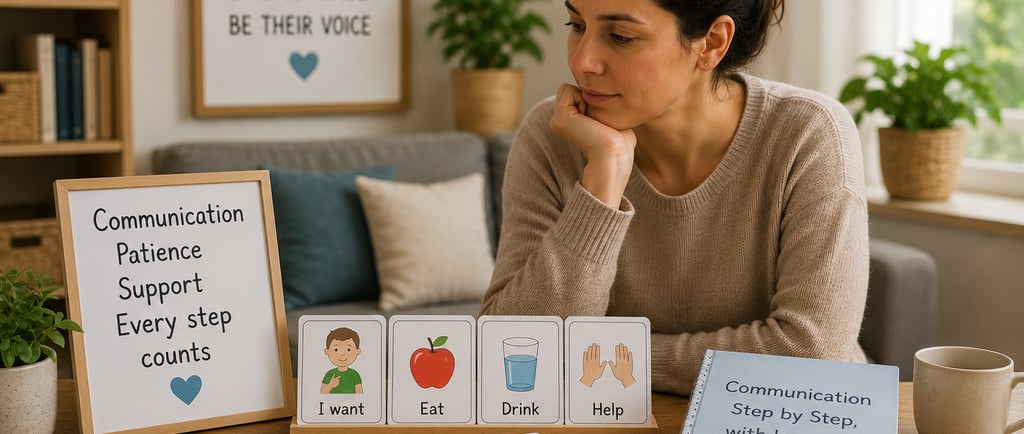
In reality, a child can communicate in many ways:
* pointing at an object;
* looking toward what they need;
* taking an adult's hand to ask for help;
* using facial expressions;
* using images or pictograms;
* using augmentative communication devices when necessary.
Learning to recognize these forms of communication is an important step toward strengthening the family bond.
- What can hinder language development?
There is no single cause.
Factors that may influence some children include:
* difficulties with social interaction;
* different sound processing;
* sensory sensitivity;
* difficulties with imitation;
* language development differences associated with ASD.
That is why it is important to avoid comparing them to other children.
- How to help a child with autism communicate at home
1. Speak using simple sentences
Avoid giving too many instructions at once.
Instead of saying:
"Let's pick up the toys, then put on our shoes because we're going to the park."
Try saying:
"Put away the car."
Then, follow up with the next instruction.
2. Leverage their interests
If they like dinosaurs, trains, animals, or building blocks, use these to create opportunities for communication.
A child's interests can become an excellent tool for learning new words.
3. Wait a few seconds before responding for them
Many children need more time to process information.
Pausing for a few seconds can encourage them to try to respond on their own.
4. Describe what is happening
Talk during everyday activities.
For example:
* "Now we're opening the door."
* "The ball is rolling."
* "Let's wash our hands."
This naturally increases exposure to language.
5. Celebrate any attempt at communication
Don't just wait for spoken words.
You can also reinforce:
* a gesture;
* a look;
* pointing at an object;
* a sound made with communicative intent.
Every attempt represents progress.
-What to avoid
Some actions can increase a child's frustration.
Avoid:
* pressuring them to repeat words;
* finishing every sentence for them;
* asking too many questions in a row;
* comparing their development to that of other children.
The goal is to create opportunities for communication, not to generate anxiety.
-When should you consult a professional?
It is advisable to seek guidance when:
* there are concerns about language development;
* the child loses words they were previously using;
* communication is very limited and affects daily life;
* parents need support on how to encourage communication.
Early assessment allows for the design of strategies tailored to each child's needs.
Conclusion: When a child with autism does not speak, the uncertainty can be overwhelming.
However, it is important to remember that communication goes far beyond words.
Many children develop new ways of expressing themselves over time, especially when they receive support, opportunities to communicate, and an environment that understands their needs.
The most important thing is not to make rapid progress.
It is to move forward while respecting each child's pace and celebrating every small achievement.
Frequently Asked Questions:
Do all children with autism speak?
No. Some develop spoken language, others use only a few words, and some employ alternative communication systems.
Can I encourage language development at home?
Yes. Daily routines, shared play, speaking in simple sentences, and following the child's interests can foster communication.
Should I be worried if my child isn't speaking?
If you have concerns about their development or notice a loss of language skills, it is advisable to consult a professional for a proper evaluation.
Explore
Join us in the adventure of parenting.
Resources
Support
2021 © 2025. All rights reserved.