
What is non-verbal communication in autism, and how can you learn to understand it?
Discover what non-verbal communication in autism is, how to recognize your child's signals, and practical strategies to strengthen communication at home.
6/26/20263 min read
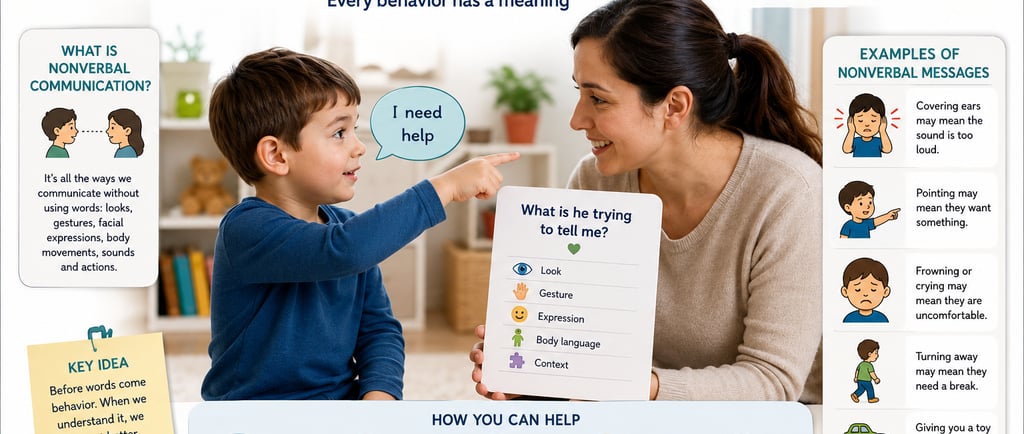
When we think of communication, we usually imagine words and conversations. However, many people with autism communicate in different ways, especially when spoken language is still developing or is difficult to use.
A glance, a gesture, a facial expression, or even the way someone approaches an object can convey important information.
Learning to recognize these signals can help reduce frustration for both the child and their family, and strengthen the bond between them.
It is important to remember that every person with autism is different. There is no single way to communicate, and not all strategies work the same way for everyone.
What is non-verbal communication?
Non-verbal communication includes all the ways of conveying information without using spoken words.
It can include:
* Glances or eye contact.
* Hand gestures.
* Facial expressions.
* Body movements.
* Pointing at objects.
* Handing over an object to ask for help.
* Moving away when something is uncomfortable.
These behaviors can serve a communicative purpose, even if they sometimes go unnoticed.
Why is it important to learn to observe?
Many children with autism express their needs through behavior before using words.
For example:
* Leading an adult to the refrigerator might mean they are hungry.
* Covering their ears might indicate that a sound is too intense.
* Handing someone a toy might be an invitation to play.
* Moving away from an activity might indicate tiredness or sensory overload.
When adults learn to observe these signals, they can respond more appropriately and reduce frustration.
- Non-verbal communication signals to look for
👀 Eye contact
Although some people with autism maintain little eye contact, this does not mean they aren't paying attention.
Many children look at an object they want, watch an activity, or seek out an adult in different ways.
A lack of eye contact should not automatically be interpreted as a lack of interest.
✋ Gestures
Some examples include:
* pointing;
* raising arms to be picked up;
* reaching out a hand to ask for an object;
* waving hello or goodbye;
* showing something they like.
Each gesture can have a different meaning depending on the context.
😊 Facial expressions
Emotions can also be expressed without words.
Observe whether your child shows signs of:
* joy;
* discomfort;
* fear;
* surprise;
* tiredness.
Recognizing these changes helps you respond before an emotional meltdown occurs.
🚶 Body movement
The body communicates, too.
For example:
* moving closer can signal interest;
* moving away can indicate a need for a break;
* rocking back and forth can help with self-regulation in some cases.
It is important to interpret these behaviors within their context and avoid jumping to conclusions.
How to strengthen non-verbal communication at home
1. Observe before intervening
Before responding, take a few seconds to observe what the child is trying to communicate.
Ask yourself:
What are they trying to tell me with this behavior?
2. Respond to their communication attempts
If they point to a cup because they are thirsty, you can respond by saying:
"You want water. Let's get some water."
This way, you associate the action with language without pressuring them to repeat words.
3. Use gestures while speaking
Accompanying words with simple gestures makes understanding easier.
For example:
* pointing to the door when saying "let's go outside";
* showing the spoon when talking about food. 4. Maintain a predictable routine
When the environment is more predictable, many children find more opportunities to communicate and participate.
5. Celebrate any form of communication
Don't just wait for words.
Also acknowledge:
* a look;
* a gesture;
* an image;
* an intentional sound;
* an action that expresses a need.
Every attempt strengthens communication.
Common mistakes
Avoid:
* assuming the child understands everything even if they do not respond;
* ignoring small attempts at communication;
* insisting solely on speech;
* interpreting all behaviors as "bad behavior";
* comparing their way of communicating with that of other children.
When should you consult a professional?
If you notice significant communication difficulties or have questions about how to interpret certain behaviors, a speech-language pathologist (or speech therapist) can guide the family and suggest strategies tailored to the child's needs.
Conclusion: Non-verbal communication is a fundamental part of development for many children with autism.
Learning to recognize a look, a gesture, or an expression can transform the way parents and children understand each other.
Words are just one of many ways to communicate.
When we learn to observe closely, we discover that children are often already telling us a great deal, even if they do not yet use spoken language.
Frequently asked questions
- Do all children with autism use non-verbal communication?
Yes, although the way they do so varies greatly from person to person.
- Does a lack of eye contact mean they aren't listening to me?
Not necessarily. Some people with autism process information differently and can pay attention without maintaining constant eye contact.
- Can I encourage non-verbal communication at home?
Yes. Observing, responding to gestures, using visual aids, and creating opportunities for interaction are strategies that can foster everyday communication.
Explore
Join us in the adventure of parenting.
Resources
Support
2021 © 2025. All rights reserved.